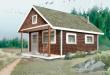
I've been kind of losing the dream lately. But I definitely could do this. This group makes micro houses for the homeless. It costs less than $1000, probably a lot less if you scrounged up materials (It's amazing what they throw away at construction sites.) These guys even tell you how to make a stove out of metal buckets. The pictures are not very instructive, but they have lists of materials that they use.
There are many types of owner built homes. I dream of building myself one someday. My favorite is stone but there are straw, cordword and even paper.
Thursday, December 07, 2006
Homeless housing-I could do that
I've been kind of losing the dream lately. But I definitely could do this. This group makes micro houses for the homeless. It costs less than $1000, probably a lot less if you scrounged up materials (It's amazing what they throw away at construction sites.) These guys even tell you how to make a stove out of metal buckets. The pictures are not very instructive, but they have lists of materials that they use.
Tuesday, August 15, 2006
Keep the heat

All this heat we are experiencing this summer reminds me of something I've always wondered about. Why can't we save the summer heat for when it's cold in the winter. It seems so elementary. But apparently it's quite difficult, because it's being done in very few places.
Don Stephens calls it Annualized Geo-Solar Design and has actually designed houses where summer heat is stored under the house in an earth mass. The earth mass needs to be above the water table and insulated or kept dry some distance out from the house.
Another way to store summer heat is in saline solar ponds. Here's another explanation (scroll to the bottom of the page). And Mother Earth News had an article about it. Now this technology is mostly being used to generate electricity, but on a smaller scale it could provide heat for a house. Of course you would need some land for the pond and you would have to be next to the ocean or in a place that has a lot of salt like Utah.
How about storing hot water in insulated tanks in the basement. The water is heated by reflecting the sun down fiber optic cable. Well, this is just a theory. Maybe someone should try it.
Update: Thinking about these methods, I realized once the water was circulating, it would lose the heat in a matter of days or less, so you would have to have a separate tank or pond for each week or couple of days. I haven't seen this aspect discussed anywhere.
Wednesday, July 19, 2006
Missile Silo Houses
Further to my post on missile silo homes, here's a real estate agent that specializes in missile properties and also underground communication centers. The latter are more interesting to me, because the holes in the ground mostly filled with water give me the creeps. One only costs $67,000. I think they could have a few more pictures of the properties for sale on the site.
Wednesday, July 12, 2006
747 House

How's this for building material, a scrapped 747 jumbo jet. In case you missed this like I did in April, according to the article, a scrapped 747 costs about $100,000. The woman talked about in the article is building a multi-million dollar home with hers, but I imagine something more modest would be possible. I wonder if all the seats are still in there. You could build a great home theater room.
This article about the same house says the 747 cost $40,000. That starts to sound feasible. Just a big problem moving it to the construction site.
Tuesday, July 11, 2006
Wall-framing with 2x6's
Your tax dollars at work. Here is some info on cost saving building by using 2x6's instead of 2x4's. They use a lot of specialized vocabulary which I don't understand like "drywall return" and "scabbed", but if you are ready to build your house it is worth a read.
Thursday, June 29, 2006
Washer-Dryers

Another I don't understand why everyone doesn't have one. A machine that washes AND dries clothes. If you have an automatic washer and an automatic dryer, why not go totally automatic and have it dry clothes too. It costs about the same as a washer and dryer together.
If you want to really save
water there is the wringer washer. But then laundry is a whole-day affair. Start with the cleanest and end with the dirtiest using the same water. My mother always had a wringer washer when I was growing up. I wonder when water will become so scarce that we will be back to wringer washers. Right now I think about the only place you can buy them is at Lehman's. They have one made in Saudi Arabia. I guess even with all that oil, water is still at a premium in the desert.
Monday, June 26, 2006
Composting toilets have come a long way.

Forget about water saving toilets. I think no water or composting toilets are the best way to handle human waste. All that manure needs to get back to the earth. There are amazing systems that actually do this. The cost depends on how much work you want to put into it. At the low end is Jenkins' bucket system as described in his book Humanure (available free online). But I could see that taking out buckets of the stuff would get old fast. And it reminds of the untouchables caste, whose job was (and still is in some parts of India) to take out buckets of feces from upper caste homes.
I like the Envirolet. They have normal looking toilets that have a duct that takes the stuff down to a floor below where the composting takes place. The cost is quite high, but then if you compare it to installing a septic tank, it is reasonable. Only problem is getting the building inspector to accept your not putting a septic tank in. There are lots of composting toilets to choose from for example Sun-mar, Biolet, Phoenix, and I believe the Clivus Multrum has been around for a long time.
And then you have to have a system for handling grey water. That will be in another post.
Wednesday, May 24, 2006
Build a cabin for less than $4000

A good article from Mother Earth News on building a cabin with boards. The guy does a pretty good job of describing the process. There are just a few things I don't understand. Probably if I read it over and over again I would get it. The $4000 doesn't include plumbing, fixtures or electrical stuff. I guess you live by candle light or use solar electricity.
These guys say you can build a nice log home for under $10,000. I would check them out before I bought a log cabin kit.
Friday, May 19, 2006
Another housebuilding blog
Here's an interesting blog about building a house. He says he is the one-man crew for his contractor, so I guess it's a self-build.
Monday, April 03, 2006
Las Gaviotas - Colombian town of the future

This is an interesting place. An engineer dedicated his life to making a barren, unlivable environment into an oasis, both literally and figuratively. Wind and sun was used to provide energy to a village in the Colombian llanos and then they brought in Caribbean pinetrees which made the soil attractive to rain forest plants turning the area back into the rain forest it was thousands of years ago.
The most significant invention is a simple hand pump capable of tapping aquifers six times deeper than conventional models, but requiring so little effort that children can operate it. In normal pumps a heavy piston must be raised and lowered inside a pipe. Gaviotas engineers realized they could do the reverse; leave the piston stationary and lift an outer sleeve of lightweight, inexpensive PVC tubing instead.The word llanos translates to plains, but the Colombian llanos are nothing like the fertile plains of the U.S. Midwest. Roads are barely there in the dry season and completely impassable in the rainy season. And in Colombia anytime you travel outside the cities and larger towns, you also travel back one or two centuries in time. Las Gaviotas just leaped over the petroleum fueled era.
For 6 months I lived in Villavicencio, which is where the llanos begin. It was 1975, but I knew nothing about Las Gaviotas, which was started in 1971. We lived in the second floor of a house. It had a nice, big patio where I washed clothes in the lavadero (a concrete water container with a washboard).
The strangest part of the house was the decorative brick walls. It had holes so that a breeze could come through, but also the mosquitoes could come in. We had netting for the baby's bed, but not for ours. We sprayed insecticide every night around the bedroom, a very common practice in tropical areas. Nothing worse than hearing the whine of a mosquito when you are trying to sleep. There was no hot water, the norm for tropical areas, in Colombia at least. The water came off the mountain, so it was very cold. I could not take such cold showers, and there was no tub, so it was sponge baths for me and the baby. Solar water heating would have been so simple to install. I wonder if people are using solar now.
Subscribe to:
Posts (Atom)